


Workforce.
Workforce Data and Intelligence
To enable the faculty to understand the extent of the problem in Devon and direct energy and resources appropriately, we needed to perform extensive scoping work to establish key parameters.
Progress
- Initial version of the HEE supply and demand tool submitted.
- System wide links with leads and informatics team to obtain and sense check data.
- Reliable source of primary care data now established
- Beginning to agree system wide main workforce challenges
- Beginning to understand system wide workforce assumptions
- ESR work done within organisations by AHP WF leads means that the next data collection should be more accurate
Support worker workforce
There are approximately 805 (675 WTE) Allied Health Profession support workers in Devon working across health care organisations, with further support workers employed in social care and PIVO organisations. Commonly term “unregistered” staff, their education levels, training needs and skill are largely unknown. This piece of work aims to support the implementation of the AHP Support Worker Competency, Education and Career Development Framework (REF) which aims to enable employers, networks, integrated care systems (ICSs) and services effectively plan, develop, and deploy their AHP support workforce effectively.
HEE’s national allied health professions support workforce programme has been established to provide support on recognising, developing, and expanding the non-registered AHP workforce. As a region, we recognise that considerable actions are required to identify the wide variation in education and training provision for the AHP support workforce and provide solutions to target these aims.
The AHP Support Worker Framework seeks to ensure:
- Patients and service users have access to skilled and consistently well-trained support workers who have a defined role within their team, service, and organisation;
- Current and prospective AHP support workers have access to accurate and up to date role descriptions and standardised career/development structures that provide opportunities to follow a richer and more rewarding career pathway;
- Support worker roles can be at the heart of improvements in service delivery and transformation, including new models of care;
- Services can address current unwarranted variation in support worker roles, banding and progression
A recent survey of ~350 AHP support workers in Devon supports the findings of the King’s College London, working with HEE and the AHP professional bodies when evaluating challenges of the support worker workforce.
Our data suggests that the overarching themes of challenges support workers face in Devon are:
- Lack of clear career structure or opportunities
- Perception of not working effectively within their scope of practice (either not being utilised to their potential or being asked to work outside their scope of practice)
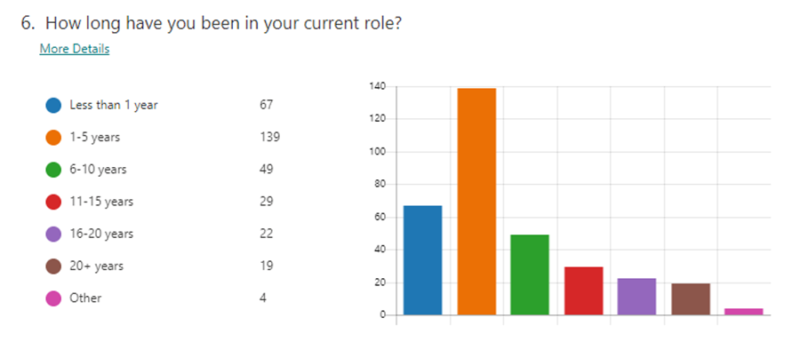
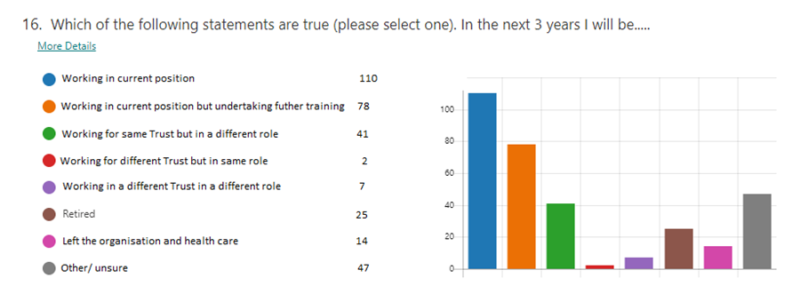
- Poor retention, with most support workers staying in the role for less than 5 years (Figure 3) and many with plans to leave their current roles/organisations (Figure 4)
Useful Links:
Further information about apprenticeships – https://haso.skillsforhealth.org.uk/
