


Category: News
The NHS in the South West is facing significant disruption to routine care this week due to industrial action, just as we enter one of the busiest periods of the year for the service.
Junior doctors across the NHS will begin striking at 7am on Wednesday (20 December), until 7am on Saturday 23 December.
With the run-up to Christmas already a busy time for the NHS, the strike is expected to have significant impact as the NHS focuses on ensuring patients needing urgent and emergency care can be treated safely.
This means some routine appointments and operations will be postponed. Hospitals are contacting people directly should their appointment need to be delayed; therefore, people should continue to attend any appointments as planned if they are not contacted.
Dr Michael Marsh, NHS England South West Medical Director, said: “The NHS is always busy during the winter months and in particular over the Christmas and New Year period as staff take a well-earned break to be with family and friends.
“Add industrial action to that pressure means the NHS has to prioritise urgent and emergency care to ensure people are cared for safely. That does mean having to postpone routine appointment and operations so that staff are freed up to cover for junior doctors.
“We are asking people to help the NHS by continuing to use 999 in life-threatening emergencies and NHS 111 online for all other health concerns. GP services and pharmacies are also available for patients and can be accessed in the normal way.
“Patients who haven’t been contacted or informed that their planned appointment has been postponed are urged to attend as normal.”
Professor Sir Stephen Powis, NHS national medical director, said: “These strikes come at a time that will cause huge disruption to the NHS, with services are already feeling the strain of winter pressure.
“When you factor in the Christmas and New Year break, these strikes will prolong that period of reduced activity and it also puts the health service on the back foot into the new year, which is a time where we see demand start to rise significantly.
“Over the holiday period, I would encourage anyone who needs medical help to continue to come forward – in a life-threatening emergency, call 999 and use A&E in the usual way. For everything else, use 111 online.”
Top tips to help the NHS over the festive period:
- Use 999 in life-threatening emergencies. If you are unsure of the service you need use NHS 111 online or by phone.
- If your loved one is in hospital and well enough to leave, help support them to get home at the earliest opportunity.
- Make sure you have enough regular medication and don’t leave repeat prescription requests until you have run out. Your own GP can help arrange an urgent medication supply if you do run out.
- Make use of pharmacies. Pharmacists are open over weekends and can give you expert, confidential advice and over-the-counter remedies for minor illnesses and ailments. You don’t need to make an appointment to see a pharmacist.
- Call your own GP – even if you’re on holiday – when surgeries are open. They offer appointment via telephone and video, so you don’t need to be there I person.
- Parents can download the free NHS HandiApp for advice about common childhood conditions.
- Check our website over the festive period to see which of your local pharmacies is open, and when: https://www.england.nhs.uk/south/info-professional/pharm-info/pharmacy-opening-hours/
Notes to editors:
- There will be a further period of industrial action by junior doctors from 7am on 3 January to 7am on 9 January.
- South West regional medical director Dr Michael Marsh is available for interview on Tuesday, 19 December. To request and interview please contact england.swcomms@nhs.net
- The pharmacy rotas for Christmas and New Year will be posted later this week, once late changes have been incorporated
NHS England South West is one of seven regions in England, covering Swindon, the Bath area, Wiltshire, the Bristol area, Somerset, Gloucestershire, Devon, Dorset, and Cornwall and Isles of Scilly. We make sure that people across the South West have access to high-quality health and care services.
Our work involves supporting the seven Integrated Care Systems (ICSs) and 23 NHS trusts in the region to ensure that together they provide excellent healthcare services that meet the needs of patients and the communities of the South West.
We do this by providing professional leadership to the local NHS on commissioning, digital transformation, assurance and delivery, finance, nursing, medical and clinical leadership.
A new national report on empowering communities to tackle health inequalities has been published. Case studies in the report illustrate the progress that can be made when communities are involved in designing services; and when cross-sector groups work together to invite people in, listen, and then make changes.
LGBT+ people face multiple barriers to support when experiencing domestic abuse which increases the time it takes to get help. In response, NHS Devon and partners across the Peninsular applied for funding to commission specialist LGBT+ Independent Domestic Violence Advisors (IDVAs). In this blog for 16 Days of Action, Helen – Intercom’s senior LGBT+ IDVA – explains why this approach is so important for LGBT+ people.
I work for Intercom Trust, a community-led charity for LGBT+ people of all ages, their loved ones, and the professionals who work with them. We provide help, support, advocacy, low-cost counselling, and family support for our LGBT+ communities.
As the senior LGBT+ IDVA I set up Safer Rainbow which supports LGBT+ victims of domestic abuse (and more recently sexual violence). We work across sexual orientation and gender identity spectrums with people facing different forms of abuse and risk of harm.
I have compiled a range of specialist LGBT+ interventions including trauma stabilisation tools, interventions to support understanding of power imbalance in LGBT+ domestically abusive relationships and the longer term impact this may have on individual wellbeing, sexual identity and future relationships.
While LGBT+ people can face similar forms of domestic abuse to their cis gendered heterosexual peers, they can also face abuse specifically related to their sexual orientation or gender identity.
There are many myths with regard to LGBT+ communities and domestic abuse which can increase barriers to seeking help. For example, the myth that partner abuse does not happen within intimate LGBT+ relationships or that abuse is about size and strength- indicating that the perpetrator of abuse will present as the more masculine in the relationship. There may be misconceptions regarding same-sex rape in women or men when the reality is that sexual assault in same-sex relationships can be equally serious.
Our clients can often be reluctant to report any incidents or issues to the police for fear of being judged, misunderstood, or that their case may not be taken seriously. My role is to support them to gain more positive experiences with police reporting, increase awareness of police diversity teams and how this can support their next steps.
Our clients confirm how it is easier to enter a service that has already learned to take on a more open-minded approach to people of any gender or sexuality. Intercom Trust as a service have experience and knowledge of the complexities of our LGBT+ communities and have a compassionate and shame sensitive approach when supporting.
I am passionate about working with LGBT+ communities for many reasons and find my role incredibly varied and rewarding; whether I am with a client at court, supporting reporting to the police, or sitting with someone who may be in the early stages of coming to terms with their traumatic experiences. I admire Safer Rainbow clients’ courage in working alongside us learning to trust a way forwards with their lives. The Project is continuing to expand and develop utilising client voice with regard to information, resources and what individuals have found beneficial.
I have always enjoyed working with groups, and recently developed and started a pilot “Empowerment and Recovery following Domestic Abuse” face-2-face 8 week group programme. We are currently running these sessions from our Exeter office and my plan is to make this a regular part of Safer Rainbow support and expand across the region.
If you’ve been affected by the issues in this blog, you can contact The Intercom Trust via the helpline 0800 612 3010 or helpline@intercomtrust.org.uk
Referrals to Safer Rainbow can be made via the Intercom Trust website on https://www.intercomtrust.org.uk/referral-form/
Doctors in Devon are reminding parents to consult the HANDi paediatric app if they aren’t sure what to do when their child is unwell.
The free app, available to download onto any Apple or Android device, was launched specifically with children in mind and is loaded with expert advice, support and guidance for parents with concerns about their children.
The easy-to-use app was designed with local paediatric consultants to provide clear, concise information for parents and carers.
It covers a range of common conditions such as high temperatures, chestiness, abdominal pain, headaches and rashes, which can cause concern to a parent or carer if they are not sure what to do.
The award-winning app asks a series of questions about the symptoms the child has and then advises the best course of action to take, whether to treat the condition at home, consult a pharmacist or GP, and if it is serious to head to the Emergency Department.
It has been specifically adapted to be suitable for people in Devon, directing users to their nearest hospital.
HANDi is updated regularly by qualified clinicians to provide the best advice and will ask users a series of short questions to identify their child’s condition, and then advise them what course of action to take.
Dr Maria Williams and Dr Melissa Lemon are two Plymouth-based GPs who are keen to share their knowledge as GPs, and experience as mums, to help support parents, guardians and caregivers with the uncertainly of looking after poorly children.
They are sharing regular health updates and trusted information about common childhood illness, specifically respiratory illness, over the winter months on Facebook and Instagram, as well as at some face-to-face drop-in educational sessions for parents with Dr Melissa Lemon across Plymouth.
Both Dr Williams and Dr Lemon are GPs at Pathfields Medical Centre in Plymouth. Dr Williams says: “As we get further into winter, we often see an increase in the number of contacts about children with cough and cold symptoms, as well as various viral illness, which are exceptionally common at this time of year.
“We are keen to share information to help people feel more comfortable about when to self-care and when to seek appropriate help, from the right setting, at the right time.”
Dr Lemon said: “We advise our patients to look at the HANDi paediatric app and the website www.what0-18.nhs.uk to find excellent information and guidance around childhood illness and links for physical and mental health issues.”
A partnership of voluntary sector representatives in Torbay have launched a new campaign to keep people healthier.
Torbay Communities’ Live Longer Better courses cover everything from diet and nutrition to outdoor and indoor fun activities that will keep people as fit as they can be.
Exercise classes were provided for most abilities, which are adaptable for use in the comfort of people’s own homes.
There were also opportunities to have a go at a range of activities, including lawn green bowling with coaching, tips and experienced players to help along the way.
Beach and sea sessions were also organised to build people’s confidence in the water – no swimming experience was necessary.
While sea dips were arranged for those who were slightly more confident but wanting support.
Finally, for those who prefer the view under the surface, there were introduction to snorkelling for beginner sessions at Broadsands.
The project began its autumn programme in Paignton, Torquay and Brixham on 16 October. While it is primarily aimed at over 50s, all ages are welcome.
For more information, visit the Live Longer Better website.
Updated 24 May 2024 (see section, ‘Current position’ below)
Estates Rationalisation Overview
This page contains information about important estates rationalisation work we are undertaking at Okehampton Community Hospital.
Background
The Devon NHS system has experienced significant financial challenges for many years, consistently spending more money on health services than it has been given to meet the needs of the 1.2 million people it serves.
This has contributed to Devon being placed in the highest segment (segment 4, sometimes known as special measures or NOF4) of the NHS Oversight Framework by NHS England.
This means Devon gets ‘intensive’ support from NHS England – which includes additional reporting requirements and financial controls – with the aim of improving its financial and operational performance.
In 2022/23, Devon’s end of year position was a deficit of £46.2 million. In 2023/24 as part of our journey to achieving a balanced budget, the forecast deficit for the county’s NHS system as a whole is £42.3 million, which includes a £212 million savings plan. However, as shown by our December Board papers, at this point in the year, we are £32.5 million adrift from where we expected to be against our plan.
We have established a system-wide programme of work to deliver the performance and financial improvements needed to allow us to move out of NOF4.
Reducing the amount of money wasted on empty space
As you would expect, we are seeking ways of saving money that do not affect NHS staff or NHS services.
The former ward at Okehampton Community Hospital has been empty and unused since 2017 and presents an opportunity for the local NHS to save more than £200,000 a year in rent and other property charges.
The beds were removed following full public consultation when new ways of looking after people in the local community – often in their own home – were brought in and they have been very successful.
The Your Future Care consultation ran from 7 October 2016 until 6 January 2017 and was led by the then-Northern, Eastern and Western Devon Clinical Commissioning Group (CCG). It focussed on proposals to provide more care and support for elderly and frail people at home and in the community. The aim was to prevent unnecessary admissions to hospital and, if patients need to go to hospital, to get home as quickly as possible, improving their chances of a better recovery.
Throughout the consultation period, the CCG attended over 70 events and public meetings. More than 2,000 people attended these events and discussed the proposals. 1,552 responses to the survey were received, in addition to more than 650 letters and emails.
Separately, ownership of Okehampton Community Hospital transferred from the then-Northern Devon Healthcare NHS Trust to NHS Property Services in 2016 when the community services contract moved from NDHT to the then-Royal Devon and Exeter NHS Foundation Trust.
NHS Property Services charges market rent and other property costs on empty space in its buildings. Where there is no tenant, these ‘void costs’ are paid by the integrated care board, in this case NHS Devon.
Since the Your Future Care consultation, vacant space at the hospital, including the empty ward and linked office space, has cost the NHS in Devon around £1 million – poor use of taxpayers’ money. The ward has been fully decommissioned, with utilities disconnected to reduce service charges.
Working with health and care partners
We have been working with local health – NHS and primary care – partners on what to do with the ward and so far no viable schemes have emerged. With all partners who have expressed an interest in occupying the space, we have been clear that any proposal would need be viable financially, which means being able to cover the cost of bringing the building back up to useable standard, reconfiguring it and then paying the annual rent and service costs. We estimate that the cost of bringing it back into a usable condition would be significant.
Generally, hospital buildings need to be built and maintained to a higher standard than normal commercial buildings, which means they can be comparatively expensive to occupy.
Meanwhile, space in the rest of the hospital, although tenanted, is significantly under-utilised.
Current position
Faced with ongoing stark financial challenges, we have started the process of surrendering this space so we can save the money being wasted.
On 28 November, we took a decision which effectively means we are in the process of handing the former ward area – made up of the empty ward, associated link corridors and ancillary space – back to the owner of the building, NHS Property Services.
Based on local discussions and our experience, we do not anticipate that local voluntary, community and social enterprise organisations would be able to take on the ward space. Although we have begun the hand back process with NHS Property Services, we will be talking to local organisations to confirm they are not able to take on the space and we would always be happy to consider any viable proposals emerging from this work.
In addition to this, in due course, we would like to widen our work with local partners to improve space utilisation in the rest of the hospital to get better value. This will be a medium-term piece of work and will involve community engagement to explore local needs and ideas. Again, any changes will need to be fully costed.
Our December board papers, published on 29 November confirm the decision of our Finance and Performance Committee to surrender the empty ward space. We are therefore sharing this news with local stakeholders and the community.
There is no proposal change to any NHS services as part of the surrender of the ward area.
UPDATE, 24 May 2024
During the process of handing back the ward area to NHS Property Services, a site development assessment was undertaken, and it was identified that maternity services could be relocated into the outpatient department in the main hospital building. This would enable the release of the maternity suite, which, combined with the empty former ward area, would provide a larger overall space for hand back that would facilitate work by NHS Property Services to market the space and find a future use for it.
The maternity area is indicated with the dotted yellow line, below, and is adjacent to the empty former ward area shown to the left.
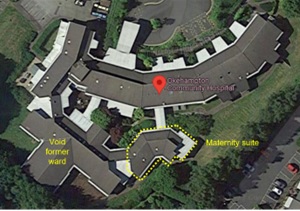
In April 2024, NHS Devon’s Finance and Performance Committee, on behalf of the NHS Devon Board, approved the handback of the maternity area to NHS Property Services. A report by the Committee Chair confirming the decision was published in NHS Devon’s Board papers on 22 May 2024 ahead of its meeting on 30 May.
There is no impact on services as a result of this decision. Current maternity services (both those in operation and those currently temporarily suspended) can be relocated into the retained main building of the adjacent hospital. The services have not yet moved and patients should continue to attend appointments as normal.
There is no impact on any other services being provided at the hospital.
Negotiations with NHSPS continue on what will happen next as the hand back process is not straightforward. If NHS Property Services accept the hand back, it would be for NHS Property Services to determine what to do with the building.
Next steps
The current position is that negotiations with NHSPS continue on what will happen next as the hand back process is not straightforward. If NHS Property Services accept the hand back, it would be for NHS Property Services to determine what to do with the building.
We will provide further information about the work to improve space utilisation in the rest of the hospital in due course.
Information about temporary arrangements during £1 million investment work at Okehampton Community Hospital
The following temporary arrangements being put in place by NHS Property Services (NHSPS), which owns the hospital.
NHSPS is undertaking some capital improvement work at Okehampton Community Hospital, which will see an investment of approx £1 million in the building.
As part of this, there is a need to temporarily relocate some teams who work in the building during the work programme.
The kitchen space has recently been cleared of the remaining kitchen utilities to enable Royal Devon University Healthcare NHS Foundation Trust community nurses and admin teams to temporarily use the space while NHSPS undertakes its capital works, which include replacement of the roof and flooring in their usually occupied areas. The works are set for completion within the next six months (dependent on weather). Items removed recently include old regeneration trollies, fridges, and tea machines that were not disposed of when the kitchen closed in 2017.
The kitchen at Okehampton Hospital has been unused since 2017 when beds were removed. Food provision remains unaffected at the hospital as there has not been any food provision at Okehampton since the closure of the ward in 2017.
Food provision across Devon has changed since the hospital at Okehampton was built, and is now prepared off-site.
The reconfiguration of the kitchen space does not inhibit future food provision if it were to become required again. Some internal windows and doorway boarding has been undertaken within the works area. This is to prevent dust contamination to the working areas of the hospital. This is standard industry practice for health & safety and infection control.
The roofing work includes the areas being handed back – this is because they had also been affected by water ingress and the works protect the internal fabric of the building, facilitating potential work by NHSPS to find future uses for the space.
A brand-new, state-of-the-art facility for people with eye conditions in Devon and Cornwall has opened in Plymouth.
Surgeons there have been learning Getting it Right First Time (GIRFT) processes from system colleagues as part of the One Devon Elective pilot.
The new Royal Eye Infirmary (REI) building includes a third operating theatre dedicated to sub-specialisms, such as oculoplastic, orbital and corneal surgeries.
As a specialism, ophthalmology (eye services) has a lower reliance on an acute hospital site, making it a suitable candidate for a move away from the Derriford Hospital site. The REI opened to the public on 9 October, with improved access for patients, a drop-off zone and parking.
TALKWORKS (Devon’s NHS Talking Therapies service) and the Devon County Football Association are launching a partnership to encourage more adults across Devon to access mental health and wellbeing support.
The partnership will see TALKWORKS supporting players, club officials and FA staff across Devon, aged 18+, who are experiencing low mood, stress, anxiety, or sleep difficulties.
The NHS service also has a dedicated Talking Health team, experienced in supporting adults with long-term health conditions, to improve their mental and physical wellbeing.
Working together, TALKWORKS and the Devon County FA want to normalise conversations around mental health, both in locker rooms and in the wider community. The NHS service were recently in attendance at Devon FA 567s small-sided football league, where they held conversations with players and staff about how to look after their health and wellbeing, both on and off the field.
An innovative Careers Hub that aims to enhance students’ access to job opportunities within healthcare and the NHS was launched by Plymouth partners earlier this month.
University Hospitals Plymouth NHS Trust (UHP), Livewell Southwest and City College Plymouth have worked together on the project.
The hub is a completely free resource available to young people in the Plymouth community, which offers them the opportunity to explore various NHS career options, initiate the development of their career paths, and seek answers to inquiries related to NHS employment.
The NHS is facing an unprecedented demand for healthcare professionals to address both current and future needs, with a particular emphasis on preparing for the years ahead.
To align with the NHS’ goal of creating a 21st century workforce by 2024/25, the NHS Careers Hub will widen participation across the city by raising the profile of the 350 different career paths within the NHS.
It will provide careers information, advice and guidance to students aged 16 to 18 in both the college and across schools in Plymouth.
The advice and guidance will not only signpost young people to one of the many vocational and academic courses on offer at City College Plymouth, but also towards apprenticeships.
During the Career Hub’s official opening, UHP’s Chief Executive Officer, Ann James, spoke about the importance of the hub giving students access to a healthcare career and creating a seamless integration of workforce development across multiple sectors within the city.
Ann said: “Our young people are the future of the NHS. We are thrilled to be part of this exciting project and look forward to continuing to work in close partnership with City College Plymouth.”
Schools interested in finding out how the Hub can help their pupils are asked to call 01752 305 300.
The offer of a seasonal autumn Covid-19 vaccination for eligible people ends on 15 December 2023. Appointments are now available to book your flu and Covid-19 jab at the same time at various locations across Devon.
People in Devon have just four weeks left to protect themselves against Covid-19, before winter. The eligibility for an autumn Covid-19 vaccine is different to the spring vaccination campaign, and local health leaders are concerned that some people may not realise they are entitled to a seasonal Covid-19 vaccine.
Those entitled to a Covid-19 vaccine before 15 December 2023 include:
- Everyone aged 65 and over.
- Household contacts of people who are severely immunosuppressed.
- Paid and unpaid carers.
- People aged 5 and over with underlying health conditions including chronic liver and heart conditions, severe mental illness, learning disabilities, diabetes and pregnant women.
- Health and social care staff.
- People who live in care homes and those who are housebound.
More information and full details of who can have a seasonal Covid-19 vaccine this autumn can be found at www.nhs.uk/wintervaccinations. In addition to being invited by the NHS, people can self-declare that they are entitled to a Covid-19 vaccine by calling 119 for free or using the online national booking service www.nhs.uk/wintervaccinations
Dr Alex Degan, GP and Medical Director for Primary Care at NHS Devon, said: “This is the shortest seasonal Covid-19 vaccination campaign that the NHS has run and we’re concerned people may not realise the cut-off date for vaccination is 15 December – in just four weeks’ time.
“In particular, some groups of people are eligible this autumn who weren’t included in the spring vaccination campaign, including unpaid carers and household contacts of people who are severely immunosuppressed. If you’re in one of these groups and haven’t already been invited for your vaccination by the NHS, you can self-declare using the online national booking service or by calling 119, for free.
“Covid-19 is still here and getting vaccinated is the best way to protect yourself, your family and the people you care for.”
Getting vaccinated is easy with 35 community pharmacies, GPs and vaccination centres offering bookable appointments across Devon.
We also have some walk-in vaccination clinics available in Devon. Details of all the ways to get vaccinated are here:
| Book using the NHS App or online | nhs.uk/nhs-services/covid-19-services/covid-19-vaccination-services/book-covid-19-vaccination/ |
| Find a local walk-in session | onedevon.org.uk/our-work/services-and-support/coronavirus/nhs-covid-19-vaccination-programme/ |
If you can’t get online, you can call 119 for free to book an appointment. You now also book your flu vaccination at the same appointment, at several vaccination centres across Devon, including Home Park in Plymouth, Greendale in Exeter and at Tesco in Barnstaple. Flu vaccines can also be booked directly through your GP practice or local pharmacy (for adults).
While flu and Covid-19 are unpleasant illnesses for most people, they can be very dangerous and even life threatening for some, particularly people with certain health conditions, older people and pregnant women. Every winter, thousands die from flu and people can still become very ill or die from Covid-19.
