


Category: News

The NHS in Devon is launching a new campaign to ask the public to ‘Think Pharmacy First’ this summer.
The campaign encourages residents and visitors to Devon, to visit their local community pharmacy for fast, expert treatment for seven common ailments such as insect bites and sore throats.
As the warmer weather brings more time outdoors, there is a surge in minor conditions that can be seen more quickly, safely and effectively by a pharmacy without the need for a GP appointment, freeing up GP appointments for patients who need them most.
The ‘Think Pharmacy First’ campaign encourages people to make use of over 200 pharmacies (over 98% of all pharmacies) across Devon for advice, treatment, and over-the-counter medications.
Superintendent Pharmacist in Okehampton Rob Skornia said: “Insect bites, sore throats and skin irritations are among the most common reasons people seek medical help in summer. Pharmacies are well equipped to deal with these issues on the spot, with no appointment needed.
“By choosing to think pharmacy first this summer, you can get treated faster and you can help reduce pressure on our busy GP practices and emergency departments”.
Four in five people in England can reach a community pharmacy within a 20-minute walk and there are twice as many pharmacies in the most deprived communities, making access to care quicker and more convenient.
Under the Pharmacy First service, trained pharmacists can provide consultations, treatments and where necessary prescription medication for a range of conditions, including:
- impetigo (aged 1 year and over)
- infected insect bites (aged 1 year and over)
- earache (aged 1 to 17 years)
- sore throat (aged 5 years and over)
- sinusitis (aged 12 years and over)
- urinary tract infections (UTIs) (women aged 16 to 64 years)
- shingles (aged 18 years and over)
If you are not within these age ranges, a pharmacist can still offer advice and support decisions about self-care treatment with over-the-counter medicines, but you may need to see a GP for treatment.
People can still choose to visit a GP if they wish to. Pharmacy First offers alternative access for these seven conditions, and we encourage people to make the most of this service and to consult the highly trained professionals in their local pharmacy.
This campaign will run throughout the summer and into the winter months, reflecting the changing health needs of the seasons—from insect bites and hay fever in summer, to coughs and colds in winter.
You can find out where your nearest pharmacy by using the NHS find a pharmacy website.
You read more about the Pharmacy First campaign, and watch the NHS explainer video on the One Devon website.
The NHS in the South West is facing another significant round of industrial action by resident doctors, who are expected to strike from 7am tomorrow (Friday) until 7am on Wednesday 30 July.
Hospitals and local teams have been preparing as usual ahead of this latest round of strikes, with plans in place to minimise disruption to patient care and to ensure life-saving treatment continues.
This will be the twelfth strike from resident doctors since March 2023, resulting in 49 days of disruption to NHS services.
NHS England has asked hospital chief executives to keep routine operations going to the fullest extent possible during this round of strikes and only to reschedule appointments and other activity in exceptional circumstances to ensure patient safety.
The NHS is therefore advising the public to continue to attend any planned appointments they have scheduled over the strike period unless they have been contacted to reschedule.
Primary and urgent and emergency care services will continue to be available for those who need them. The public should use 111 online as the first port of call for urgent but not life-threatening issues during industrial action so that they can be directed to the best place for their needs.
Patients who need emergency medical care should continue to use 999 or come forward to A&E as normal.
Dr Trevor Smith, NHS England’s Regional Medical Director for the South West, said: “It’s very disappointing that the industrial action is going ahead, given the impact it will have on individual patients, many of whom will have been waiting a long time for treatment.
“Some cancellations are inevitable as we prioritise emergency care, but we’re doing all we can to keep other services running, so please do attend appointments unless you’re told otherwise.
“And as always, please dial 999 in an emergency, and make use of NHS 111 online, your local pharmacist or GP if it’s less urgent.”
The last round of national industrial action by resident doctors at the end of June last year saw 61,989 inpatient and outpatient appointments rescheduled, with 23,001 staff absent from work due to strike at its peak.
Since strikes began at the end of 2022, the cumulative total of hospital appointments rescheduled is now close to 1.5 million (1,486,258) across the NHS.
Resident doctors, previously named junior doctors, make up around half of all doctors in the NHS and have up to eight years’ experience working as a hospital doctor, depending on their specialty, or up to three years in general practice.
Full advice for public and patients is available here.
Women in Devon are being encouraged to attend their routine cervical screening checks when invited.
Each year, around 2,700 women are diagnosed with cervical cancer in England, with proportionally more people being diagnosed in the South West when compared to the national rate.
Just 68.8% of women currently take up the offer of cervical cancer screening, well below the NHS England target of 80%.
Screening helps prevent cervical cancer by detecting abnormal cells in the cervix before they develop into cancer.
Devon GP Dr Alex Degan, who is also Primary Care Medical Director at NHS Devon, said: “Cervical cancer is one of the most preventable cancers, so all women should book their screening appointment as soon as they receive their invitation. Cervical screening lasts just a few minutes and saves lives.
“Many women miss cervical screening because of fear or embarrassment, so if you have any concerns, you can discuss these with your GP or practice nurse before or at your appointment, and they can advise and support you during the process.”
Cervical cancer is one of the most preventable cancers, yet two women die every day from the disease. It is most common in women aged between 30 and 35, but it can happen at any age.
Nearly all cervical cancers are caused by high-risk human papillomavirus (HPV), a common virus that’s spread through skin contact (usually when having sex).
More accurate human papillomavirus (HPV) testing will enable millions of women and people with a cervix in England to benefit from more personalised cervical screening from this month.
From July, younger women (aged 25 to 49) who test negative for HPV, meaning they are at very low risk of cervical cancer over the next 10 years, will safely be invited at 5-year intervals rather than 3, in line with major clinical evidence.
Those whose sample indicates the presence of HPV or who have a recent history of HPV, which causes nearly all cervical cancers, will continue to be invited to more frequent screenings to check HPV has cleared and if not, if any cell changes have developed.
The HPV vaccine protects against most types of HPV, preventing 9 out of 10 cases of cervical cancer. It’s quick, safe, and the best protection you can get against future cancer risk. The NHS offers the HPV vaccine to boys and girls from the age of 12-13. Girls under 25 and boys born after 1 September 2006 who missed their HPV vaccine at school, can also catch up at their GP.
Dr Degan added: “By getting the HPV vaccination and attending screenings when invited, you’re giving yourself the best possible protection against cervical cancer.
“Even if you’ve had a HPV vaccination it’s important that you attend your cervical screening appointment when invited because the HPV vaccine doesn’t protect against all strains of HPV.”
NHS cervical screening helps prevent cervical cancer by using a highly effective test to check for HPV, which is found in over 99 per cent of all cervical cancers and which may cause abnormal cells to develop in the cervix. These abnormal cells can, over time, turn into cancer if left untreated.
Invitations are sent in the post when it’s time to book a cervical screening appointment, while women can also contact their GP surgery to book. Some sexual health clinics also offer the service.
Anyone who has previously received an invitation and been unable to attend shouldn’t wait for another invitation – you can still book a cervical screening appointment even if invited weeks, months or years ago.
More details on NHS cervical screening and how to book an appointment are available at www.nhs.uk/conditions/cervical-screening.
- Prime Minister launches government’s 10 Year Health Plan to bring the NHS closer to home.
- Neighbourhood Health Services to be rolled out across the country, bringing diagnostics, mental health, post-op, rehab, and nursing to people’s doorsteps.
- Neighbourhood health centres will house services under one roof, open at evenings and weekends.
- Plan for Change will rebuild the NHS to train thousands more family doctors, transform hospital outpatient appointments, and provide personalised care plans for complex needs.
Millions of patients will be treated and cared for closer to their home by new teams of health professionals, Prime Minister Keir Starmer will set out today, as the Government’s Plan for Change delivers a brand-new era for the NHS and delivers one of the most seismic shifts in care in the history of the health service.
The launch of a Neighbourhood Health Service will see pioneering teams, some based entirely under one roof, set up in local communities across the country, to dramatically improve access to the NHS. As part of the Government’s aim to shift care out of hospitals and into the community, they will free up overstrained hospitals from perpetual firefighting so they can focus on delivering only the best, most cutting-edge, and personalised care.
These neighbourhood health centres will provide easier, more convenient access to a full range of healthcare services right on people’s doorsteps – stopping them from having to make lengthy trip to hospitals. Neighbourhood teams will include staff like nurses, doctors, social care workers, pharmacists, health visitors, palliative care staff, and paramedics. Community health workers and volunteers will play a pivotal role in these teams, and local areas will be encouraged to trial innovative schemes like community outreach door-to-door – to detect early signs of illness and reduce pressure on GPs and A&E.
Launching the government’s 10 Year Health Plan today, the Prime Minister will set out how moving care from hospitals to the community is one of the three key shifts required to tackle the inherited challenges and neglect of the NHS, make sure it is equipped to look after a modern society, and ensure people feel the change and improvements in healthcare that they voted for.
Prime Minister Keir Starmer said:
“The NHS should be there for everyone, whenever they need it.
“But we inherited a health system in crisis, addicted to a sticking plaster approach, and unable to face up to the challenges we face now, let alone in the future.
“That ends now. Because it’s reform or die. Our 10 Year Health Plan will fundamentally rewire and future-proof our NHS so that it puts care on people’s doorsteps, harnesses game-changing tech and prevents illness in the first place.
“That means giving everyone access to GPs, nurses, and wider support all under one roof in their neighbourhood – rebalancing our health system so that it fits around patients’ lives, not the other way round.
“This is not an overnight fix, but our Plan for Change is already turning the tide on years of decline with over four million extra appointments, 1,900 more GPs and waiting lists at their lowest level for two years.
“But there’s more to come. This government is giving patients easier, quicker and more convenient care, wherever they live.”
The plan follows Lord Darzi’s diagnosis of the challenges facing the NHS last year where he assessed it was in a ‘critical condition’ as a result of deep rooted issues including low productivity, poor staff morale, a failure to keep up with new technology, rising waiting times, and a deterioration in the health of the nation.
The PM will set out how the plan will deliver three key shifts to get the NHS back on its feet: hospital to community; analogue to digital; and sickness to prevention. Built around these three principles, the reforms within the plan will deliver the government’s promise to stop rising waiting lists, deliver more convenient care, and tackle inequalities across the country.
New health centres will house the neighbourhood teams, which will eventually be open 12 hours a day, six days a week within local communities. They will not only bring historically hospital-based services into the community – diagnostics, post-operative care, and rehab – but will also offer services like debt advice, employment support and stop smoking or weight management, all of which will help tackle issues which we know affect people’s health.
Health and Social Care Secretary Wes Streeting said:
“Our 10 Year Health Plan will turn the NHS on its head, delivering one of the most fundamental changes in the way we receive our healthcare in history.
“By shifting from hospital to community, we will finally bring down devastating hospital waiting lists and stop patients going from pillar to post to get treated.
“This Government’s Plan for Change is creating an NHS truly fit for the future, keeping patients healthy and out of hospital, with care closer to home and in the home.”
The status quo of ‘hospital by default’ will end, with a new preventative principle that care should happen as locally as it can: digital-by-default, in a patient’s home where possible, in a neighbourhood health centre when needed, in a hospital if necessary. This approach will make access to healthcare more convenient for patients and easier to fit around their day to day lives, rather than disrupting people’s work and personal lives.
Thousands more GPs will be trained under the 10 Year Health Plan, as the Government lays the groundwork to bring back the family doctor, end the 8am scramble and make it easier to see your GP when you need to instead of having to turn to A&E.
The government inherited an analogue NHS, reliant on paper and fax machines and out of step with modern technology. The government’s plan will bring it into the digital age, making sure staff benefit from the advantages and efficiencies available from new technology. This includes rolling out groundbreaking new tools over the next two years to support GPs. AI scribes will end the need for clinical notetaking, letter drafting, and manual data entry to free up clinicians’ time to focus on treating patients. Saving just 90 seconds on each GP appointment can save the same time as adding 2,000 more doctors into general practice.
The Government will also use digital telephony so all phone calls to GP practices are answered quickly. For those who need it, they will get a digital or telephone consultation the same day they request it.
As it stands, some practices are struggling to keep up with an ageing population and 21st century health needs. New contracts will be introduced which encourage and allow practices to cover a wider geographical area. It means smaller practices in the catchment area will get more support to ensure the right access is in place so that everyone can access their GP when they need to.
Sir James Mackey, Chief Executive, NHS England said:
“The Neighbourhood Health Service is a huge opportunity for us to transform how we deliver care over the next decade – starting right on people’s doorsteps.
“By bringing together a full range of clinicians as one team, we can deliver care that’s more accessible, convenient and better for patients, as well as reducing pressures on hospitals.”
The plan will also deliver on the government’s promise to tackle the current lottery of access to dentists. Dental care professionals will work as part of neighbourhood teams, where Dental therapists could undertake check-ups, treatment, and referrals, while dental nurses could give education and advice to parents or work with schools and community groups. The work therapists cannot do would be safely directed to dentists.
Under the plan, it will also be a requirement for newly qualified dentists to practice in the NHS for a minimum period, intended to be 3 years.
Following the government’s work already to roll out supervised toothbrushing for kids, the plan will also improve access to dental care for children, making better use of the wider dental workforce, especially dental therapists, including through a new approach to upskilling professionals to work at the top of their clinical potential beginning in 2026 to 2027. This includes proposals to allow dental nurses to administer fluoride varnish for children in between check-ups, and the greater use of fissure sealants for children – covering back teeth with thin plastic coating to keep germs and food particles out the grooves.
Matthew Taylor, Chief Executive of the NHS Confederation, said:
“This is a vital step towards a more preventative, community-based NHS. Bringing care closer to people’s homes through blended neighbourhood health teams recognises the complex and interconnected challenges many patients face, and it is the right direction for both improving outcomes and alleviating pressure on hospitals.
“In many areas of the country, general practices working at scale through primary care networks and GP Federations, are already partnering alongside other organisations to deliver joined up care. It will be important to build on these positive successes.
“Delivering on this ambition will require sustained investment in digital and estates, support for the NHS’s workforce, and a commitment to decentralise national control by empowering local leaders to do what is best for their populations. On behalf of our members, we are eager to work with the government to help turn this bold vision into lasting change.”
With the 10 Year Health plan the majority of outpatient care will happen outside of hospitals by 2035, by transforming care in the community. New digital tools will allow GPs to refer patients quicker, and a wider range of services available on people’s doorsteps will mean less need to attend appointments in hospital for ophthalmology, cardiology, respiratory medicine, and mental health.
As a result of this shift to community, hospitals will be able to focus on patients who need hospital care, and get them seen on time again.
The government’s Plan for Change is already delivering action to cut waiting lists and fix the foundations of the NHS. Waiting lists are at their lowest level in two years, including the first drop in April for 17 years. An extra 4.2million appointments have been delivered since July – over double the government’s target. 10 new surgical hubs have opened since January, and over 1,500 more GPs have been recruited since October.
Further details:
- Where neighbourhood health teams have been trialled in England, they have significantly reduced hospital use. In Derby, integrated teams led to 2,300 fewer Category 3 ambulance callouts and 1,400 fewer short hospital stays among the over 65 population within a year.
- The Institute For Public Policy Research has already called for a neighbourhood NHS – arguing a strong primary care sector has been shown to deliver better health outcomes, fewer hospital and emergency department trips, and more efficient healthcare spending.
- As well as improving access to care for patients, The move to more care in the community will put the NHS back on the path to long-term financial sustainability. A recent study found that £100 spent on community care could achieve, on average, £131 in hospital savings.
- Care plans are vital to seamless care within the community, but only 20% of people with a long-term condition have one. Through the 10 Year Health Plan, the Government will set a new standard that, by 2027, 95% of people with complex needs have an agreed personal care plan. All care plans should be co-created with patients. This means neighbourhood teams can tailor care for specific patients, working with them and their loved ones to proactively manage their conditions instead of simply reacting and treating emerging issues as is the case under the current system. This is especially important for people with complex needs who are likely to be managing multiple conditions.
- Unpaid carers will be actively involved in care planning, with family, friends and carers agreeing decisions about care together where appropriate.
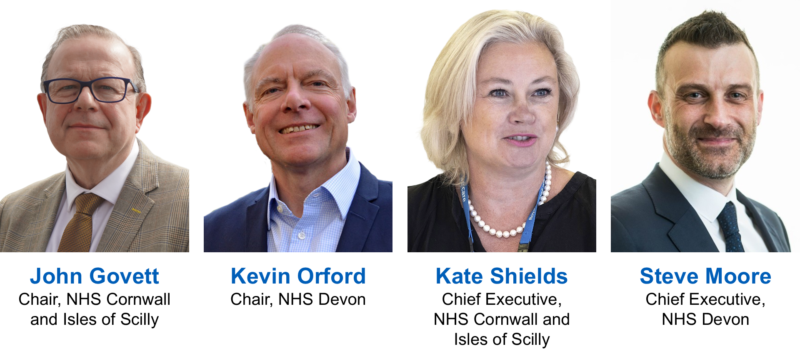
We have received confirmation from NHS England and government ministers that our new ‘cluster’ – covering Devon, Cornwall and the Isles of Scilly – has been formally approved.
This is part of a national move to bring together Integrated Care Boards (ICBs) into 26 clusters across England, down from the current 42.
‘Clustering’ means that, although both ICBs will continue to exist, we will work as one – with a single Board, leadership team and staffing structure.
This is ahead of a formal merger, which is expected from either April 2026 or April 2027, subject to local government reorganisation and further guidance.
In the south west, the seven current ICB will transition into three clusters as follows:
- Devon and Cornwall and Isles of Scilly (two ICBs)
- Bristol, North Somerset and South Gloucestershire (BNSSG), and Gloucestershire (two ICBs)
- Somerset, Dorset, and Bath and North East Somerset, Swindon and Wiltshire (BSW) (three ICBs)
While there are still important details to be worked through – such as arrangements for continuing healthcare, safeguarding, and services for people with special educational needs and disabilities (SEND) – we are moving forward with purpose to ensure a smooth transition that prioritises the needs of local people.
Leadership and transition
To support this change, we will shortly begin the process to appoint a new Cluster Chair and Chief Executive.
These roles will help lead the development of our future operating model and ensure continuity and stability through this period of change.
We expect appointments to be confirmed by the end of July.
Alongside this, work is also underway to develop our structure and implementation plan in line with a national Model ICB Blueprint that was published in May.
The Blueprint outlines the core roles and functions that ICBs will be responsible for with a significantly reduced running costs budget – a 33% reduction for NHS Devon and 38% for NHS Cornwall and Isles of Scilly.
National work is also underway to clarify how the new NHS operating model will function, and we expect more information to be shared over the summer.
What this means for partners, patients and the public
While this is a change in structure, our focus remains firmly on the health and wellbeing of our population. Our commitment to high-quality, compassionate care for people in Cornwall, the Isles of Scilly and Devon is unchanged.
Our absolute priority this year is to continue providing high-quality patient care and reduce waits whether that is waits for surgery, waits for an ambulance, waits to be seen in the emergency department or waits to be discharged with hospital.
We will continue to work in partnership with local authorities, voluntary organisations, community leaders and others to ensure that services are designed and delivered around the needs of our communities – especially those who are most vulnerable or face health inequalities.
Thank you
Thank you for your ongoing support and collaboration. These changes are designed to strengthen our ability to work together – across organisations and boundaries – to provide better, more joined-up care for our population.
We will continue to keep you informed and engaged as this work progresses.
With thanks and best wishes,
John Govett, Chair, NHS Cornwall and Isles of Scilly
Kevin Orford, Chair, NHS Devon
Kate Shields, Chief Executive, NHS Cornwall and Isles of Scilly
Steve Moore, Chief Executive, NHS Devon
Parents in Devon are being asked to make sure their children are vaccinated against measles as the disease spreads across the UK and Europe.
Measles is among the most contagious diseases in the world, but two doses of the MMR vaccine during childhood can offer lifelong protection. However-vaccine uptake in Britain is below recommended levels, and cases have been rising.
The UK Health Security Agency (UKHSA) has also warned that the spread of measles in Europe could put families at risk on their summer holiday. This year, outbreaks have been seen in several European countries, including France, Italy, Spain and Germany.
Dr Alex Degan, a GP in Devon and primary care medical director at NHS Devon, said: “It’s essential that everyone, particularly parents of young children, check all family members are up to date with two MMR doses, especially if you are travelling this summer for holidays or visiting family.
“Measles cases are picking up again in England, and outbreaks are happening in Europe and many countries with close links to the UK.
“Measles spreads very easily and can be a nasty disease, leading to complications like ear and chest infections and inflammation of the brain, with some children tragically ending up in hospital and suffering life-long consequences.
“Nobody wants that for their child, and it’s certainly not something you want to experience when away on holiday.”
If you aren’t sure whether your child has received both doses of the MMR vaccine, you can check their Red Book (child health record) or contact your GP.
Data published in May 2025 showed there have been 420 laboratory-confirmed cases of measles in England since the start of this year. Of those, two in three cases (66%) were in children aged 10 and under, but measles has also been diagnosed in young people and adults.
Since the introduction of the measles vaccine in 1968, at least 20 million measles cases and 4,500 deaths have been prevented in the UK.
Getting vaccinated means you are also helping protect others who can’t have the vaccine, including infants aged under one year and people with weakened immune systems, who are at greater risk of serious illness and complications from measles.
However, measles remains endemic in many countries around the world, and with declines in MMR vaccine uptake observed over the last decade, exacerbated by the COVID-19 pandemic, we have also seen large measles outbreaks in Europe and other countries.
Record numbers of patients in Devon are now accessing healthcare services through the NHS App.
In January, the number of repeat prescriptions ordered through the app went above 100,000 for the first time. Orders for March and April also reached the milestone, with May achieving a record 107,200.
The NHS App hosts a range of features that enable patients to access key services from the comfort of their homes.
As well as ordering repeat prescriptions – and nominating a pharmacy where you would like to collect them – you can use the NHS app to:
- Book and manage appointments.
- View your GP health record to see information like your allergies and medicines (if your GP has given you access to your detailed medical record, you can also see information like test results)
- Book and manage COVID-19 vaccinations.
- Register organ donation decisions.
- Choose how the NHS uses your data.
Each prescription ordered electronically saves GP practices three minutes and a patient 18 minutes, making it more convenient for people and freeing up frontline staff to do other important duties.
Dr John McCormick Chief Clinical Information Officer at NHS Devon and a GP Partner at Kingskerswell & Ipplepen Health Centre said:” It is great that a growing number of people living in Devon are embracing managing their healthcare digitally.
“It’s convenient for patients and helps reduce workload for practices, thus contributing to reducing pressures on the healthcare system in Devon overall.”
To use the NHS App or log in through the NHS website, you must be aged 13 or over and registered with an NHS GP surgery in England.
To set up a login, you need an email address and a mobile or landline number. This login will also give you access to lots of health and care websites and apps, including NHS services, online pharmacies, patient access services, and online consultation services.
Depending on your GP surgery or hospital, you may also be able to use the NHS App to:
- Message your GP surgery or a health professional online
- Contact your GP surgery using an online form and get a reply
- access health services on behalf of someone you care for
- View and manage your hospital and other healthcare appointments
- View useful links your doctor or health professional has shared with you
- View and manage care plans.
Dr McCormick added “Whether it’s for shopping or banking, apps are transforming every aspect of people’s lives, and the NHS is no different.
“The NHS App started just five years ago, but with a significant amount of hard work behind the scenes, it is now helping millions of patients across the country – whether it’s booking an appointment, sorting a prescription, or checking your records.
“Just a few years ago, people had to go to a GP for a paper prescription, but now, via the NHS app, it can be done at the touch of a button, which is a truly transformational change and so much more convenient for patients.
“The NHS is already world-leading in population coverage of the app, but I’d encourage anyone who hasn’t already downloaded it to give it a go and see how easy it is to manage their healthcare from the palm of their hand.”
NHS Devon has issued a ‘last call’ for at-risk patients eligible for the spring 2025 Covid-19 vaccine.
The spring booster campaign ends on June 17, and patients who meet the criteria are being urged to book before it’s too late.
Covid-19 is more serious in older people and those with certain underlying health conditions. For these reasons, the vaccine is being offered to people:
- Aged 75 years and over
- In care homes
- Aged six months and over with a weakened immune system.
Devon GP Dr Alex Degan, who is also Primary Care Medical Director at NHS Devon, said: “Covid-19 can still be dangerous for vulnerable people, so it’s important they come forward for their jab.
“Vaccination can help protect you from becoming seriously ill or needing to go to hospital so, if you’re eligible, I strongly urge you to take up your offer of vaccination before June 17.
“It’s quick and easy to book an appointment online via the National Booking System or by calling 119. Just provide your postcode and you’ll be offered a range of appointment times, dates and locations near you.”
The National Booking System at www.nhs.uk/bookcovid will remain open until 16 June.
In addition, walk-in vaccinations are available, with information updated on a daily basis on the NHS website.
NHS Devon is pleased to announce upcoming changes to several services supporting the emotional health and wellbeing of children and young people across the One Devon system.
As part of the organisation’s commitment to the national ambition of ensuring Mental Health Support Teams (MHSTs) are available in all education settings by 2029/30, NHS Devon will be commissioning two additional MHSTs to begin training this year.
This expansion will bring the total number of MHSTs in Devon to 16, enabling support for approximately 105,000 children and young people once the teams are fully operational.
To learn more about the Mental Health Support Teams, please visit:
- Devon and Torbay: Children and Families Health Devon
- Plymouth: Livewell Southwest
In addition, throughout 2024/25, NHS Devon led a collaborative procurement process involving expert stakeholders from across One Devon.
This process focused on commissioning emotional wellbeing and mental health services – outside of existing arrangements with Livewell Southwest and Children and Family Health Devon – in a way that ensures equity, effectiveness, and sustainability.
Following a robust and competitive process, the Young Devon Partnership was awarded the contract for a newly designed Emotional Wellbeing & Mental Health Service.
This service will support young people aged 11-18 to access timely advice, guidance, and therapeutic support, whether online or within their communities. It will include a youth work-based offer, digital advice and therapy, and face-to-face therapeutic interventions.
This new service will replace the existing provision from Young Devon and Kooth. NHS Devon is currently working closely with the Young Devon Partnership to mobilise the new service, which will become operational in July 2025.
As part of this transition, some areas may experience changes in how emotional wellbeing support is accessed.
The new model is designed to work flexibly across communities, ensuring young people receive support in the settings most appropriate to them.
In particular, secondary schools in Plymouth may see a shift away from fixed, school-based resources to a more responsive, community-oriented approach.
Additionally, the Systemic Family Therapy service provided by Family Matters in Plymouth will come to an end in June 2025.
The service is no longer accepting new referrals and is focusing on completing work with families currently engaged.
While family-based approaches remain an important aspect of our mental health services, there are currently no specific alternative family therapy services commissioned through NHS Devon.
Accessing support
Young people can still access a wide range of support options:
- Visit provider websites for self-help resources, digital guidance, and service information
- Speak to a Children’s Wellbeing Practitioner or MHST member within their school
- Contact their GP for further support
- In a mental health crisis, call NHS 111 to speak with a mental health professional.
NHS Devon has submitted ten GP practices for the Government Primary Care Utilisation and Modernisation (U&M) Fund. The U&M Fund is a government initiative providing £102 million in capital funding to improve primary care facilities across the country. The money is to support improvements in primary care facilities, including renovations, extensions and new builds.
The Government has announced that all ten of the schemes submitted by NHS Devon will now be considered by the Government. At this stage none of the schemes have been approved for U&M funding.
If approved, the modernisation schemes at these practices would provide 29 new clinical rooms in Devon.
Paul Green, Director of Primary Care at NHS Devon, said: “This has been a great example of collaborative working across the primary care health system in Devon. It is a positive step forward in the process to secure investment in GP practice infrastructure in the county. We have been as proactive as we can to give the Devon schemes the best chance possible of being approved. Where needed, planning applications have been submitted and approved by local councils.
“GP practices in Devon have a good track record patient satisfaction and access has always been rated highly in national surveys. If approved, these improvements will make a massive difference to the experience of patients and staff at those surgeries.”
Notes:
- The total cost of the improvements for all ten schemes would be £2.9m, with £2.1m requested from the U&M fund.
- The ten surgeries are:
- Ashburton Surgery
- Beaumont
- Brannam Medical Centre
- Buckland Surgery
- Clare House Surgery
- Ivybridge Highlands
- Pinhoe Surgery
- Queens Medical Centre
- St Levan Surgery
- Topsham Surgery
