


Category: News
- Throughout March and April 2025, agencies across Devon, Cornwall, and The Isles of Scilly including local councils, NHS, law enforcement, and charities are collaborating on a local Stop It Now campaign to deter online child sexual abuse.
- As people across the UK continue to view sexual images of children online, and engage in online sexual grooming of under-16s, this longstanding campaign from national charity the Lucy Faithfull Foundation is celebrating its tenth year.
- Last year, 8037 people in Devon and Cornwall sought help from the Stop It Now helpline (0808 1000 900) or online self-help, concerned about their own or someone else’s online sexual behaviour towards children.1
- Viewing sexual images of under-18s and sexual conversations with under-16s are illegal, causing huge harm to children, and there are serious consequences including potential arrest, imprisonment and job loss. But there is confidential help available to stop via the anonymous Stop It Now helpline.
Agencies across Devon, Cornwall, and the Isles of Scilly are joining forces with UK-wide charity the Lucy Faithfull Foundation on a campaign to stop online child sexual abuse.
15 agencies and partnerships have pledged to take part in the campaign across NHS, local councils, law enforcement, and charities. These include Devon and Cornwall Police, NHS Devon, NSPCC Together for Childhood, Cornwall Council, Council of the Isles of Scilly, Devon and Torbay Probation Service, Our Safeguarding Children Partnership for Cornwall and The Isles of Scilly, Safer Cornwall, Cornwall and The Isles of Scilly Safeguarding Adults Board, Devon Safeguarding Children’s Partnership, Safer Plymouth, Devon and Cornwall SARC, University Hospitals Plymouth NHS Trust, Devon Partnership NHS Trust, and Royal Devon University Healthcare.
The campaign follows news that 275,000 people in the UK received support from Stop It Now helpline or online self-help last year. In Devon there has been a 29% increase in people seeking help from Stop It Now in 2024 compared to 2023, with Cornwall seeing a 37% increase.2
Working together, these agencies also aim to raise awareness of the scale and nature of online child sexual abuse in the local area, and how to stop it. This includes viewing sexual images of under-18s and online sexual grooming.
Viewing sexual images of under-18s and sexual conversations with under-16s are illegal, causing huge harm to children, and there are serious consequences including potential arrest, imprisonment and job loss. But there is confidential help available to stop via the anonymous Stop It Now helpline.
So that everyone knows what they can do to keep children safe, the campaign will include webinars for professionals, alongside print, broadcast, and social media to reach the general public. The campaign will signpost anyone in Devon, Cornwall, and The Isles of Scilly concerned about online sexual behaviour to the anonymous Stop It Now helpline to prevent child sexual abuse – before it happens.
Tom Squire, Head of Clinical Engagement at Lucy Faithfull Foundation said:
“This campaign in Devon and Cornwall spotlights the problem of online child sexual abuse. It’s so important to have the active support of so many local agencies committed to preventing child sexual abuse in Devon and Cornwall.
“People who view sexual images of under-18s or have sexual conversations with children under 16 online come from all backgrounds and walks of life, and there is no one type of person who engages in this behaviour.
“People viewing sexual images of under-18s or having sexual conversations with under-16s online need to know that such behaviour is illegal and causes great harm. There are grave consequences once your behaviour is detected by police. But there is help to stop. Contact Stop It Now on 0808 1000 900 or visit www.stopitnow.org.uk for anonymous advice and support.”
Sheon Sturland, Devon and Cornwall Police Chief Superintendent said:
“Devon and Cornwall Police is pleased to support the work of the Lucy Faithfull Foundation, as whilst we will always tenaciously investigate any reports of the sexual abuse of a child in order to secure a conviction and the strongest possible sentence, we would rather that the harm such crimes cause didn’t happen in the first place.
“We will apply the same vigour to whatever form of abuse is reported to us, it does not matter when it happened. What someone who views sexual images of children needs to understand is that lasting harm has been caused to the children in the images, and that looking at them encourages other people to create more of them and so perpetuates and encourages further harm and abuse. Viewing sexual images of children is, of course, illegal in itself.
“It’s encouraging that last year more than 8,000 people in Devon, Cornwall and the Isles of Scilly sought help from the Stop It Now helpline (0808 1000 900) or online self-help service. Seeking help and support from the Lucy Faithfull Foundation will, we hope, do exactly what this campaign proposes and stop abuse before it happens.
“However I must be crystal clear that the consequences for anyone who sexually abuses a child are severe. Since September of last year we have seen fifteen individuals in court for abuse, including both physical and online, which resulted in prison sentences ranging from 38 months to 30 years, a total of over 214 years. They were all local men aged between 31 and 73, some of the crime were recent, others not. For those sent to prison, there will also be the subsequent job losses and potential family breakdowns.
“We urge anyone concerned about their own or someone else’s online sexual behaviour towards children to use the Stop It Now helpline.”
Penny Smith, Chief Nurse, NHS Devon Integrated Care Board, said:
“NHS Devon is committed to working collaboratively with partners to protect children from sexual abuse. The trauma of sexual abuse is significant, it impacts upon children’s health and wellbeing, upon families and upon our communities.
“Without the right support, we know that trauma can have lasting impacts into adulthood. We recognise the opportunities that health practitioners must identify children at risk and ensure that they are safeguarded. It is important that we also take a proactive, preventative approach and do all we can to reach those at risk of harming children.
“If you are concerned about your own thoughts or that of someone close to you, there is confidential, professional help available to address this before a child is harmed.”
Louise Arscott, Head of Devon and Torbay Probation, said:
“Child sexual abuse perpetrators face some of the strictest supervision from the probation service as their crimes can lead to lifelong trauma for their victims. Offenders are also subject to thorough risk assessments, specialised treatment and cognitive behavioural therapy.
“In our day-to-day work, we encourage people who have already been through court, to use the helpline to support them once they have completed their sentence.
“If you are at risk of offending, get in touch with the Stop it Now helpline before you harm someone and before you come to the attention of the criminal justice system.”
Shelley Shaw, Development and Impact Manager at Together for Childhood Plymouth, said:
“New and emerging technology is creating more opportunities for children to be sexually abused which is why we continue to support the Stop It Now campaign.
“Whilst the recent Online Safety Act is designed to make tech companies more accountable and responsible for the content placed on their platforms there is also an increasing need to help people who are concerned about their own thoughts and behaviours and to give them access to support to prevent them from offending.
“The success of the previous three Stop It Now campaigns in Plymouth has shown that people do access confidential help and advice when they know about it.
“We hope that this latest campaign aimed at prevention will help more people across Devon and Cornwall.”
Bill Shields, NHS Devon’s chief finance officer (CFO) and deputy chief executive, will be joining NHS Derby and Derbyshire and NHS Nottingham and Nottinghamshire on 1 April as their joint CFO.
Bill has been an integral part of NHS Devon’s leadership team over the past few years, playing a key role in strengthening the organisation and system’s financial performance and strategy.
Bill has been temporarily supporting Torbay and South Devon NHS Foundation Trust with additional capacity and leadership for the past few months, including most recently as their interim chief executive.
Ahead of Bill starting his new role and Torbay’s new incoming chief executive, Joe Teape, joining on 3 March, there will be a handover period to ensure a smooth transition and continuity in leadership.
Arrangements for NHS Devon’s CFO recruitment will be confirmed in due course. In the meantime, Kirsty Denwood will continue to oversee the finance, estates and digital portfolio.
Steve Moore, NHS Devon’s chief executive, said: I’d like to take this opportunity to thank Bill for his leadership during his time in Devon. His expertise has been instrumental in strengthening our organisation and system’s financial strategy and performance, and we wish him all the best for the future.”
- In November 2024 the NHS in Devon launched local engagement around the 10 Year Health Plan
- NHS Devon has received over 2,500 pieces of feedback so far
- NHS Devon wants to encourage anyone who has not yet given feedback to complete the survey before 5pm on Friday 28 February
Local people in Devon have one week left to share their experiences, views and ideas that will contribute to the development of the national 10-Year Health Plan whilst informing local priorities in Devon. There is a dedicated webpage, which includes a link to the Devon 10-Year Plan survey.
The NHS in Devon launched local engagement around the 10 Year Health Plan in November 2024, which has run in parallel with the national Change NHS campaign. People are being encouraged to fill in the local survey even if they have already completed the national one. This is to ensure that insights from local people can be used to improve local services.
Steve Moore, Chief executive at NHS Devon, said: “The response from local people to the NHS Devon engagement around the 10 Year Health Plan has been incredible.
“We have received over 2,500 pieces of feedback so far via the survey, postcards, drop-in events and workshops.
“Everybody’s experience of using the NHS in Devon, positive or challenging, can help us shape services in the future.
“We want to hear from as many people as possible, so if you haven’t shared your views, there is still time to complete the survey online.”
The local and national public engagement exercises will help shape the government’s 10 Year Health Plan, which will be published in spring 2025 and will be underlined by three big shifts in healthcare:
- hospital to community
- analogue to digital
- sickness to prevention
For people who are unable to submit their feedback online, Healthwatch Devon, Plymouth and Torbay are offering to collate feedback over the phone. People can access this support by calling 0800 520 0640.
As part of the engagement, the Government and NHS Devon are also keen to hear from people who work in the NHS and in social care about their experiences.
Steve concludes: “I want to thank everyone who has got involved so far for taking the time to share their feedback and I also want to thank Healthwatch Devon, Plymouth and Torbay for their support to run our events.”
Thousands more breast cancers could be detected earlier in England next year in a major new NHS drive to support more women to attend potentially life-saving breast screening.
The NHS in England has today launched its first-ever awareness campaign to highlight the benefits of screening and encourage more women to make the most of regular mammograms, as figures show more than four in ten (46.3%) invited for the first time don’t act on their invitation.
The campaign – supported by leading charity Breast Cancer Now – launches with a new advert across TV, radio and online to highlight that screening can detect any cancers as early as possible, while providing reassurance and relief to millions of women who get the all-clear.
New NHS estimates suggest that if screening attendance could be improved to 80% of those eligible next year (2025/26), nearly a million more women (around 925,000) could be screened, compared to 2022/23 – with over 7,500 additional breast cancers detected at an earlier stage, when they are more treatable.
The landmark NHS campaign sees celebrities including Newsnight anchor Victoria Derbyshire, broadcaster and presenter Julia Bradbury, and Strictly Come Dancing judge Shirley Ballas write ‘unofficial’ invitation letters to women about their personal experiences of screening to reassure them and encourage them to attend. They are joined by cancer survivors, NHS staff and TV doctors in sharing letters in a number of moving films launched today.
In her open letter to women invited for screening, Victoria Derbyshire said: “I’ve had breast screening multiple times. For me it was painless and I was happy to be screened; my motivation was to make sure any irregularities were picked up – because the earlier breast cancer is detected, the greater the chance of survival. When I was diagnosed, I thought I wouldn’t get to see my two little boys grow up (then aged 8 and 11). I thought I wouldn’t get to grow old with my partner Mark. I’m still here thanks to the skill of the NHS – 2025 will be 10 years since I was diagnosed. Breast screening might just help save your life. Please go.”
The campaign comes as a new survey of 2,000 women for the NHS showed that almost 40% rarely or never talk about breast screening with their female friends and families, and almost a quarter (24%) of women said they wouldn’t attend if they didn’t already have symptoms like a lump.
More than a fifth (21%) also said that embarrassment at being topless in front of someone would prevent them from attending. Concerns about screening being painful (18.5%) also feature. However, 83.2% said they would attend breast screening if they were invited.
NHS national cancer director, Dame Cally Palmer, said: “Breast screening detects breast cancers earlier and saves lives – but we know for many women there can be lots of reasons why they might be reluctant to come forward, or why it’s not top of the priority list in their very busy lives. That’s why the NHS has today launched its first-ever campaign to support more women to make the most of breast screening and to address some of the misgivings and misconceptions they might have.
“We hope that by hearing other women’s stories, it will reassure them and remind them why screening is so important. Cancer survival is at an all-time high in England thanks to a real focus on early detection – and we want hundreds of thousands more women to access screening so that any breast cancers can be spotted as early as possible to help save more lives.”
Thanks to the hard work of NHS teams, the number of women attending breast screening has risen since 2020/21, with latest data for 2022/23 showing that 4.30 million women had been screened in the last three years (66.4% of those eligible).
Latest data on the proportion of the number of women who attend screening after being invited (uptake) shows around a third are still not attending, which increases to 46.3% of those invited for the first time.
When Liz Jadav from Kennington in London turned 50, she received an appointment letter for her first breast screening. After her appointment, she was asked to return for more tests. Although Liz had no symptoms and was otherwise fit and healthy, the results confirmed that she had breast cancer. She was thankful that the cancer had been caught at an early stage, and to be able to start discussing treatment straight away.
Liz had been about to start a job with the Royal Shakespeare Company, so her first question after diagnosis was, ‘How is this going to affect my work?’ Her employer was very supportive. Liz attended the first day of rehearsals, underwent surgery to remove the cancer on the second day, and was back with the company by the end of the week. Following the success of the surgery, Liz received radiotherapy; she will continue taking a daily pill for a few more years to reduce the risk of cancer returning, and attends yearly mammograms.
Liz said: “I think lots of women are worried about a cancer diagnosis and this puts them off from going to their screening appointment. But the mammogram isn’t cancer. The mammogram is knowledge. Without my mammogram I wouldn’t have known that I had breast cancer. I wouldn’t have been offered treatment. And lots of other things might not have happened. I’d say, when you’re invited for breast screening, make the time to go to your appointment. You’ll be glad you did.’
Amanda Pritchard, NHS chief executive, said: “Lives are saved when cancers are caught early, and we hope this first-of-its-kind campaign for the NHS will help encourage thousands more women to have more regular breast screening.
“If we can help more people access NHS screening, we have a real opportunity to detect thousands more breast cancers early and ultimately save more lives.
“Getting your screening sorted can help to provide reassurance if you are concerned, and attending your appointment could help save your life.”
Jo Harby, director of health information at Cancer Research UK, said: “Every day, more than 150 people are diagnosed with breast cancer in the UK. Thanks to the national breast screening programme, thousands of cancer cases are detected at an earlier stage when treatment is more likely to be successful. Improving access for people who want to attend screening is vital, and using digital tools, such as the NHS app, is one way to help with this.
“It’s your choice whether to attend breast screening, and that’s why it’s so important to read the information that comes with your invitation. Screening is for people without symptoms – if you notice any changes that aren’t normal for you, don’t wait for your next screening invite, talk to your doctor.”
Public Health Minister, Ashley Dalton, said: “As someone living with metastatic breast cancer, I know the importance of screening and early diagnosis. I urge all women to come forward for screening when they are contacted by the NHS – it could be life saving.
“Over the coming year, the investment and reforms this government is making will see an extra 100,000 patients are seen on time. We have also started using the latest AI technologies to help catch the disease earlier.
“We will publish a dedicated national cancer plan this year, to make Britain a world leader in saving lives, and to make the NHS fit for the future through our Plan for Change.”
Last year alone, NHS breast screening services detected cancers in 18,942 women across England, which otherwise may not have been diagnosed or treated until a later stage, and the most comprehensive review to date found around 1,300 deaths are prevented each year by the breast screening programme.
Women registered with a GP are automatically invited for NHS breast screening for the first time between the ages of 50 and 53, then every three years until their 71st birthday – while women aged 71 and over can self-refer for screening.
While most women attending screening will receive peace of mind that they have no early signs of breast cancer, the NHS encouraged women to ensure they continue to check their breasts regularly between their screening appointments and to get any unusual changes checked out by their GP.
Breast screening does have some risks. Some women who have screening will be diagnosed and treated for slow-growing breast cancers that may never otherwise have been found or caused them harm. Mammograms also do not always find a cancer that is there, but most people feel the benefits of breast screening outweigh the possible risks.
As part of efforts to drive uptake of breast screening, the NHS is launching a new “ping and book” service, with women already starting to get alerts to their phones via the NHS App to remind them they are due or overdue an appointment, with new functionality being developed to enable millions to book screening directly through the NHS App next year.
The NHS is diagnosing more people than ever before with cancer at an early stage, and latest monthly figures show the NHS met the cancer faster diagnosis standard in November for the eighth month out of the last ten, with 77% of people getting the all clear or a cancer diagnosis within four weeks.
NHS England confirmed last month that the performance standard would be increased so that 80% of patients receive a diagnosis or have cancer ruled out within 4 weeks by March 2026. This change will see around 100,000 more patients who are referred for cancer checks receive a diagnosis or the all-clear within 4 weeks next year.
The South Devon Lower Limb Therapy Service (LLTS) is helping change lives thanks to its work with a social prescriber.
The LLTS delivers specialist treatments for patients with lower limb ulceration – a physically and mentally debilitating condition, which has led to an increase in patients requiring social (non-medical) support. It is a partnership between a local voluntary sector organisation and Torbay and South Devon NHS Foundation Trust.
This support has been provided by Sue Chapman from Teignbridge Community and Voluntary Services as LLTS’s social prescriber – a role that connects people with people to activities, groups and services in their community to help them with issues such as loneliness, debt or stress.
Sue assesses these patients ensuring their social needs are met, from assessed benefit support, food vouchers for those who could not afford to feed themselves, organising deep cleans and signposting patients struggling with loneliness to community groups.
In the first 12 months, Sue has supported 68 patients, carers and families with 130 interventions. Sue has helped households secure £142,000 of annual benefit income and a further £17,500 in backdated claims, enabling patients and carers to meet the challenges they face. Feedback from patients has been great with 40% reporting improved optimism for the future.
Sue’s support is changing people’s lives, reversing what has been a distressing and lonely life to one of hope and positivity, promoting individual empowerment and self-care.
The social prescriber’s role has proven the importance of collaborative working across Devon’s health and social care services.
A partnership initiative that helps children develop critical communication skills is having a transformative impact in Devon schools.
Language enrichment groups, delivered by Children and Family Health Devon (CFHD) which is an alliance of local NHS organisations, to children in reception classes through to year six, have already reached over 90 schools across the county.
The groups focus on enhancing children’s vocabulary, listening skills, sentence construction, and confidence in communication through screening assessments and resources. Designed for early learners, the initiative supports schools in addressing the growing need for speech and language development among young children.
Hannah Burton, Specialist Speech and Language Therapist at CFHD, said: “It has been fantastic to be part of supporting schools across the county. The schools have an initial introduction session and are then sent everything they need to roll out the groups in their schools.
“Therapists then offer follow-ups throughout the school year via an online meeting. The groups are divided into six stages and each stage has a screening tool and all resources to be able to deliver 20 targeted language sessions in school.”
An ambitious programme to transform care across Devon’s acute hospitals and community sites has moved a step closer.
University Hospitals Plymouth NHS Trust (UHP) and Torbay and South Devon NHS Foundation Trust (TSDFT) have formally signed a contract for an electronic patient record (EPR) for the three hospital trusts with supplier Epic.
This contract signing signifies a major step forward in the shared vision to implement a single EPR across Devon. And by investing in a system from the same supplier, the three acute NHS trusts in Devon will be making the most of digital advances.
Epic uses cutting-edge technology to create an EPR where staff can access patients’ health and care information quickly and securely. For patients, this will mean they don’t have to remember their medical history or repeat the same information to different members of staff, making their care journey more joined-up.
Professor Adrian Harris, Chief Medical Officer at the Royal Devon University Healthcare NHS Foundation Trust and Senior Responsible Officer for the One Devon EPR programme, said: “Our electronic patient record is already helping us to transform care for patients in North and East Devon.
“Collaborating across Devon will help us to embed change on a wider scale and make Epic as effective as possible for local people and communities.”
Her Majesty The Queen officially opened the new Exeter Sexual Assault Referral Centre (SARC) on Thursday 6 February, with the unveiling of a plaque.
The opening of the new facility also coincided with national Sexual Abuse and Sexual Violence Week.
SARCs support people who have been raped, sexually assaulted or abused at any time in their life.
Queen Camilla has worked in support of those who have experienced sexual violence for a number of years, and initiated the Wash Bag project in 2017, which provides essential toiletries to individuals using SARCs.
Dame Shan Morgan, Chair of the Royal Devon University Healthcare NHS Foundation Trust, said: “We are extremely proud at the Royal Devon to provide this vital service to people across the South West peninsula, and it was with great pleasure that we welcomed the Queen to open our new centre to highlight the important work our teams do working with our partners.”
SARCs are available 24 hours, 365 days a year and are open to anyone, regardless of age, sexual orientation or gender identity who may need their services.
The creation of the new Exeter centre was made possible with funding from NHS England with support from the Royal Devon University Healthcare NHS Foundation Trust through which the SARC services are provided.
The Exeter centre offers expanded, state-of-the-art facilities and is one of the first SARCs in England to meet new exacting forensic examination standards.
It also offers advanced medical services, as well as specially designed therapy suites, and is a paediatric centre of excellence.
Lyndsay Howell, General Manager of Devon & Cornwall SARC said: “We work tirelessly to raise awareness of our work to help ensure that anyone who has experienced sexual harm knows that there is specialist help and support available.
“Having our new centre officially opened by Her Majesty has been a great honour for all our team, and we hope this will help highlight the safe and dedicated care we provide for anyone who may need our services.”
There are also SARCs in Plymouth and Truro, providing support throughout the region.
The centres can also help with sexual health information, emergency contraception and referrals to other support services if required.
Access to SARC is by appointment only, and the service offers a 24-hour information line: 0300 303 4626.
For more information on Devon and Cornwall SARCs, please visit the Devon and Cornwall SARC website.
Young people in Devon are being urged to take up their HPV vaccine to guard against the virus that can lead to certain types of cancer.
HPV (human papillomavirus) is the name of a common group of viruses that are easy to catch through skin contact (usually when having sex).
All children aged 12 to 13 (school Year 8) are offered the HPV vaccine. However, if they missed getting vaccinated when they were 12 or 13, the HPV vaccine is available for free on the NHS for:
- All girls under 25
- Boys born after 1 September 2006.
Dr Alex Degan, a Devon GP, said: “The HPV vaccine is extremely effective in helping to prevent HPV-related cancers from developing in boys and girls.
“While uptake rates are good among children offered the vaccine in school Year 8, we need to ensure more young people ‘catch up’ if they miss the original offer, for any reason.
“So, we urge young people to take up this potentially life-saving vaccine when offered.
“If you missed your HPV vaccine, you can contact your GP practice or visit a local sexual health clinic to arrange an appointment.”
While most types of HPV are harmless, some are linked to an increased risk of certain cancers, including cancer of the cervix, mouth, anus, penis, vulva and vagina, and genital warts.
The NHS HPV vaccination programme in England has been shown to have dramatically lowered HPV infections and rates of cervical cancer in vaccine-eligible women, with the strongest effects seen in those offered vaccination at younger ages. HPV vaccination also protects men and women against genital warts and other cancers of the genital areas and anus, as well as some mouth and throat (head and neck) cancers.
Contact your school, college, or university vaccination team, GP surgery or sexual health clinic for more information or to get the vaccine, or alternatively you can contact your local NHS Devon vaccination support line:
- East and Mid Devon, Exeter and South Devon/Torbay – 07729300349
- North Devon – 07385934988
- West Devon and Plymouth – 07729300350
Dr Sharif Ismail, Consultant Epidemiologist at UKHSA, said: “The HPV vaccine is one of the most successful in the world, now given as just a single dose helping to prevent HPV related cancers from developing in boys and girls.
“We urge young people to take up this potentially life-saving vaccine when offered. Look out for the invitation from your school and if you missed your HPV vaccine, you can contact your GP practice to arrange an appointment – you remain eligible to receive the vaccine until your 25th birthday.”
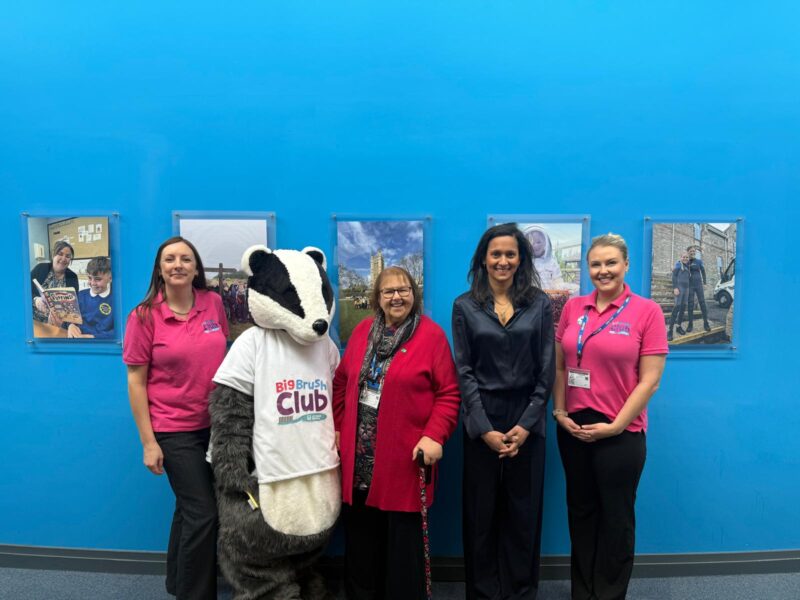
- A scheme to support three- to five-year-olds with cleaning their teeth, known as the Big Brush Club, has now been expanded to all nursery, pre-school and reception settings at primary schools in Devon
- Devon is the first area in the south west to expand supervised toothbrushing to all primary schools
- This expansion coincides with the launch of a regional Big Brush Club competition supported by rapper Professor Green
A supervised toothbrushing scheme, known as the Big Brush Club, has been running in some areas of Devon, Plymouth and Torbay since 2023. However, the scheme, which is provided for 3-5 year old children in key stage 1, is now being rolled out to all primary schools in Devon who have an early years nursery, pre-school or reception class provision.
It is funded by NHS Devon, in partnership with Devon County Council, Plymouth City Council and Torbay Council, and delivered by dental provider At Home Dental.

Jonathan Bouwer-Davies, Clinical Dental Adviser for NHS Devon said: “We know a quarter of five-year-olds have tooth decay which can, in severe cases, lead to children needing hospital treatment.
“Understanding how to brush your teeth properly is an important life skill for children. It takes schools five minutes a day and the benefits can be life-long.
“I am proud that Devon is the first area in the south west to extend the scheme to all primary schools thanks to the collaboration between NHS Devon, Devon County Council, Plymouth City Council and Torbay Council.”
Under the scheme, teachers hold short, daily toothbrushing sessions for three- to-five-year-olds alongside lessons about self-care, healthy eating and reducing sugar.
Chief Operations Officer from At Home Dental, Hayley Beaumont, said: “Our team of dental nurses work closely with teachers, pupils and parents to provide advice, support and training on promoting oral health.
“Each child is provided with a toothbrush and toothpaste pack to take home, encouraging toothbrushing to be a part of their normal daily routine.
“The children love doing it with their friends and the teachers report that it not only reduces problems with teeth but also school absence.”
Rapper and health activist Professor Green is helping the NHS raise awareness among families about the importance of children looking after their teeth, by launching an exciting competition to all primary schools across the south west.
Every child aged between three – five years old has been invited to take part in a competition with a music category and a colouring category. The competition, which will run until the end of May, will give children the chance to win some fantastic prizes for both themselves and their school. Professor Green will join a judging panel for the competition.
Professor Green said: “I am chuffed to be able to support the NHS supervised toothbrushing in schools scheme, and to be judging a competition which gives young children a creative outlet, while also teaching them the importance of brushing their teeth at least twice a day.”
He says he only realised later in life how not brushing properly twice a day affected his own physical and mental health – so now takes this seriously with his own son alongside a healthy diet.
Oral health is seen as a marker of wider health and social care inequalities including poor nutrition and obesity.
Prof. Maggie Rae, South West Deputy Public Health Director at the Office for Health Improvement and Disparities, concludes: “The Big Brush Club is a fantastic example of forward-thinking, early intervention work that supports the government’s mission to improve the health of the nation.
“The NHS in the south west is absolutely committed to tackling the many unfair disparities of health outcomes across our society.”
