


Oral antipsychotics shared care frequently asked questions (FAQs).
Last updated: 5 October 2026
1. Interim Care LES
1.1 Why has the Interim Care LES been introduced?
The Interim Care LES has been developed to support practices in the ongoing care of patients prescribed oral antipsychotic medication while they await specialist review. It recognises the additional prescribing, monitoring and care currently being provided within primary care.
1.2 How does the Interim Care LES relate to Shared Care?
The Interim Care LES forms part of the wider Oral Antipsychotic Shared Care pathway.
The LES supports practices to continue providing appropriate prescribing, monitoring and patient care whilst specialist reviews are undertaken and ongoing management arrangements are agreed.
Where a patient is considered suitable for shared care following specialist review, and a Shared Care Agreement is accepted by the practice, the patient should transition from the Interim Care LES to the Specialised Medicines Service (SMS) LES.
1.3 Does the Interim Care LES replace specialist review?
No. The Interim Care LES is intended to support patients whilst they await specialist review and does not replace specialist assessment.
Secondary care providers will review patients according to the agreed prioritisation process and determine the most appropriate ongoing management plan, which may include:
- A formal Shared Care Agreement.
- Ongoing specialist prescribing and management.
- Deprescribing.
- An alternative treatment or management plan.
1.4 Does the Interim Care LES support the specialist review programme?
Yes. The Interim Care LES has been developed to support patients and practices whilst specialist reviews are undertaken across Devon. It provides a funded interim arrangement that enables continuity of care while patients progress through the agreed review and prioritisation process.
2. Eligible Patients
2.1 Which patients are included?
Adult patients prescribed oral antipsychotic medication in primary care who are not currently managed through an established shared care arrangement.
2.2 Which patients are excluded?
Exclusions include:
- Patients under 18 years of age.
- Patients already covered by a formal Shared Care Agreement and claimed through the SMS LES.
- Patients prescribed injectable (depot) antipsychotics.
- Patients prescribed antipsychotics for non-mental health indications (e.g. palliative care, Huntington’s disease).
- Patients prescribed antipsychotics for behavioural and psychological symptoms of dementia (BPSD)
- Patients initiated on antipsychotic treatment independently by a GP without specialist recommendation.
2.3 Are patients prescribed oral antipsychotics for the management of BPSD included?
No. Patients prescribed antipsychotics for the management of BPSD are excluded from the Interim Care LES. Separate formulary guidance covering these patients has been published. Further information in FAQ section Behavioural and Psychological Symptoms of Dementia (BPSD)
2.4 Are patients prescribed depot/injectable antipsychotics included?
No. Patients prescribed depot/injectable antipsychotics are excluded from the Interim Care LES.
Existing shared care arrangements are already available for depot antipsychotics across the Devon Partnership NHS Trust footprint and practices can claim the relevant SMS LES payment where shared care has been established. Further information regarding arrangements for Livewell Southwest patients will be communicated separately as development work progresses.
2.5 Are patients with Emotionally Unstable Personality Disorder (EUPD) included?
Yes. Patients are not excluded from the Interim Care LES on the basis of diagnosis alone. Practices may claim for eligible patients prescribed oral antipsychotics, including those with EUPD, while they await specialist review, provided they are not otherwise excluded from the LES.
3. Referrals and Prioritisation
3.1 How do I request a specialist review for a patient?
For eligible patients, a request must be submitted through the Electronic Referral Service using the agreed oral antipsychotic patient review request form and prioritisation framework. Further information in section 10: Shared Care Documentation
3.2 What happens after a specialist review request is submitted?
Following submission, review requests will be received and screened by the relevant secondary care provider. Using the information provided within the clinical prioritisation framework completed by general practice, patients will be allocated to the appropriate review list according to clinical need and risk.
3.3 Will incomplete specialist review requests be accepted?
Practices are expected to complete all sections of the review request form. An Ardens form has been created to assist with pre-population of information. Incomplete referrals will be returned or rejected where there is insufficient information.
3.4 How are patients prioritised?
Patients will be prioritised using the agreed clinical prioritisation framework completed by General Practice, which considers risk and clinical need.
3.5 Will all patients receive a specialist review?
The intention of the specialist review request process is for all eligible patients to receive a specialist review. Reviews will be undertaken according to prioritisation and available capacity.
3.6 How long will patients wait for review?
Review times will vary depending on prioritisation, referral volumes and service capacity.
4. Advice and Guidance Support
4.1 What support is available while patients are awaiting specialist review?
GPs can access specialist advice and guidance via telephone and/or email from both local providers
4.2 How can a GP access specialist advice?
Devon Partnership NHS Trust (DPT)
Telephone: 01392 674900
Email: dpt.medsquery@nhs.net
Available Monday to Friday, 10:00am to 4:00pm (excluding Bank Holidays)
Livewell Southwest (LSW)
Email: livewell.antipsychoticadviceguidance@nhs.net
Available Monday to Friday, 10:00am to 4:00pm (excluding Bank Holidays)
4.3 Who will respond to requests for advice and guidance?
Requests will be received and clinically triaged by appropriately trained mental health professionals within the relevant secondary care provider. Internal triage and escalation processes will be used where required.
5. Specialist Review Outcomes
5.1 What could happen following a specialist review?
Following review, a patient may:
- Be eligible for shared care (paperwork issued to practice)
- Not be eligible for shared care (prescribing responsibility transferred to secondary care if ongoing antipsychotic treatment required)
- Be considered for deprescribing
- Have an alternative treatment or management plan recommended
5.2 What if a patient is not suitable for shared care?
The specialist team will determine the most appropriate ongoing management plan and communicate this to the GP practice.
6. Monitoring and Clinical Responsibilities
6.1 What is expected of practices while patients are awaiting review?
Practices should continue prescribing and undertake appropriate drug safety and physical health monitoring to support patient safety and continuity of care while awaiting specialist review.
The specific monitoring required will depend on the patient’s individual circumstances and should be informed by clinical judgement, relevant national guidance and, where applicable, the Oral Antipsychotic Shared Care Guidelines. Practices should also consider whether additional interventions or support may be appropriate, including physical health reviews, smoking cessation support, alcohol or substance misuse services, social prescribing, or other locally available services.
6.2 What monitoring is required once Shared Care has been established?
Once a Shared Care Agreement has been established, the patient will transition from the Interim Care LES to the SMS LES. The specific monitoring requirements will be detailed within the relevant Shared Care Guideline and will be confirmed by the specialist team as part of the shared care process.
7. Escalation and Deterioration in Mental Health
7.1 Does the oral antipsychotic review request process replace referral to CMHT?
No. The oral antipsychotic review pathway has been developed to facilitate specialist review of patients prescribed oral antipsychotic medication.
Patients requiring assessment, intervention or ongoing support from secondary mental health services should continue to be referred through existing CMHT and mental health service pathways.
7.2 What should I do if a patient’s condition deteriorates while awaiting specialist review?
Patients whose mental health deteriorates while awaiting specialist review should be managed through existing mental health referral, escalation and crisis pathways, as clinically appropriate.
The Interim Care LES and oral antipsychotic review pathway do not replace existing urgent, emergency or crisis mental health pathways.
8. Claiming and Payments
8.1 When does the Interim Care LES commence?
The Interim Care LES will go live in September 2026.
All practices are asked to complete the Oral Antipsychotics in Primary Care – Interim Care Pathway LES by 30th October 2026 to formally declare whether they wish to participate in the Interim Care LES for the period 1st April 2026 to 31st March 2027.
8.2 Are payments backdated?
Yes. Practices participating in the LES can claim retrospectively for eligible patients backdated to 1st April 2026. This recognises the prescribing, monitoring and continuity of care already being provided by practices for patients prescribed oral antipsychotic medication.
8.3 How do I claim for activity between 1st April and 31st August 2026
Due to limitations within the Commissioning Intelligence (CI) Portal, claims relating to the period 1st April 2026 to 31st August 2026 cannot be submitted electronically.
Practices will therefore be required to submit a one-off manual retrospective claim for this period using the approved claim template. Claims should be submitted to devon.primarycare@nhs.net
Claim form template:
8.4 How do I claim from 1st September 2026 onwards?
Claims relating to activity from 1st September 2026 onwards should be submitted retrospectively through the Commissioning Intelligence (CI) Portal.
The CI Portal will be available from 1st October 2026, allowing practices to submit claims in line with standard LES claiming arrangements.
Practices should only claim for patients who meet the eligibility criteria of the Interim Care LES and who are not being claimed through the Specialised Medicines Service (SMS) LES.
8.5 How often are payments made?
The Interim Care LES is claimed retrospectively on a monthly basis, in line with other Local Enhanced Services. Payments will be made quarterly in accordance with the normal LES payment process.
8.6 When should a patient move from the Interim Care LES to the Specialised Medicines Service (SMS) LES?
Once a Shared Care Agreement has been accepted by the practice and the relevant documentation has been received and recorded within the clinical system, the practice should stop claiming under the Interim Care LES and where applicable begin claiming under the SMS LES from the appropriate date.
8.7 Can a patient be claimed under both the Interim Care LES and SMS LES?
No. Patients must only be claimed under one LES at any given time. Once a Shared Care Agreement has been established and where applicable the patient transitions to the SMS LES, practices must stop claiming for that patient under the Interim Care LES.
9. Specialised Medicines Service (SMS) Local Enhanced Service (LES)
9.1. What is the SMS LES?
The SMS LES is the established Devon-wide framework used to support and fund primary care activities associated with agreed medicines prescribed under formal shared care arrangements. It provides a consistent approach to remunerating practices for the prescribing, monitoring and clinical responsibilities associated with these medicines.
9.2. How can I confirm whether my practice has signed up to the SMS LES?
If you are unsure whether your practice participates in the SMS LES, please contact devon.primarycare@nhs.net
9.3. Where can I find the SMS specification?
A copy of the SMS LES specification can be requested by emailing devon.primarycare@nhs.net or downloaded via the Commissioning Intelligence (CI) portal Specifications and Sign Up page.
9.4. Which oral antipsychotic drugs have been added to the SMS LES?
- Amisulpride
- Aripiprazole
- Haloperidol
- Olanzapine
- Quetiapine
- Risperidone
9.5 What payment tiering has been given to each of the oral antipsychotic drugs in the SMS LES?
| Oral Antipsychotic | Payment Tier |
| Amisulpride | 2 |
| Haloperidol | 2 |
| Olanzapine | 2 |
| Quetiapine | 2 |
| Olanzapine | 2 |
9.6 Why is there no SMS funding associated with aripiprazole?
Oral aripiprazole has been included within the Oral Antipsychotic Shared Care programme and is covered by an approved Shared Care Guideline. However, as negotiated with Devon LMC, within the current SMS LES framework, oral aripiprazole does not qualify for funding. This is based on the following assumptions:
- The GP prescribes and has shared responsibility for aripiprazole.
- There is no ongoing recall system with follow-up for patients prescribed aripiprazole.
- There is no ongoing drug safety monitoring required for aripiprazole
- It is estimated that aripiprazole use in Devon is established in > 1 in 500 patients.
10. Shared Care Documentation
10.1 Where can I find the Oral Antipsychotic Shared Care Documentation?
All oral antipsychotic shared care resources are available via the One Devon Clinical Guidance for Prescribers webpage and the Devon Formulary.
10.2 Where can I find the Shared Care Guideline for a specific oral antipsychotic?
The approved Oral Antipsychotic Shared Care Guidelines can be accessed via the links below or through the One Devon Clinical Guidance for Prescribers webpage.
| Oral Antipsychotic | Guideline Link |
| Amisulpride | https://onedevon.org.uk/download/oral-amisulpride-sms-devon/ |
| Aripiprazole | https://onedevon.org.uk/download/oral-aripiprazole-sms-devon/ |
| Haloperidol | https://onedevon.org.uk/download/oral-haloperidol-sms-devon/ |
| Olanzapine | https://onedevon.org.uk/download/oral-olanzapine-sms-devon/ |
| Quetiapine | https://onedevon.org.uk/download/oral-quetiapine-sms-devon/ |
| Risperidone | https://onedevon.org.uk/download/oral-risperidone-sms-devon/ |
10.3 Where can I access the Patient Review Request Form?
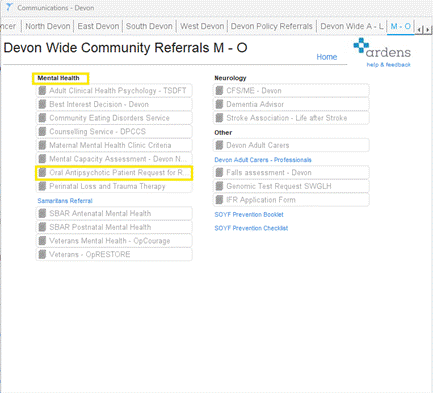
The Oral Antipsychotic Patient Review Request Form is available as an Ardens clinical template within EMIS and SystmOne, supporting completion and pre-populating relevant patient information where available.
Completed requests should be submitted via the Electronic Referral Service (eRS) using the agreed referral route below:
Devon Partnership Trust: DPT Antipsychotic Review Request Service
Livewell: Antipsychotic Shared Care Requests
SystmOne
EMIS


For EMIS users, please click here for information on how to locate the documents via the F12 key.
11. Behavioural and Psychological Symptoms of Dementia (BPSD)
11.1 Why are patients prescribed antipsychotics for Behavioural and Psychological Symptoms of Dementia (BPSD) excluded from the Oral Antipsychotic Shared Care Programme?
Patients prescribed antipsychotics for BPSD are excluded from the Oral Antipsychotic Shared Care Programme because their treatment and review requirements differ from those of patients prescribed antipsychotics for mental health conditions such as schizophrenia, bipolar disorder or psychosis.
Separate formulary guidance has been developed to support prescribing of antipsychotics in this patient group.
11.2 Why has separate guidance been developed for BPSD patients?
Patients prescribed antipsychotics for BPSD often require a different clinical approach, including consideration of dementia-specific risks, treatment duration, review requirements and deprescribing opportunities.
Separate guidance has therefore been developed to support appropriate prescribing, monitoring and review of antipsychotic treatment in dementia.
11.3 Can patients prescribed antipsychotics for BPSD be claimed under the Interim Care LES?
No. Patients prescribed antipsychotics for BPSD are excluded from the Oral Antipsychotics Interim Care LES and should not be claimed under this scheme.
11.4 Should patients prescribed antipsychotics for BPSD be submitted using the Patient Review Request Form?
No. The Patient Review Request Form should not be used for patients prescribed antipsychotics solely for BPSD.
Practices should instead follow the dedicated BPSD formulary guidance.
11.5 Where can I find the BPSD guidance?
General guidance on the management of BPSD is available via the Devon Formulary: N&E Devon / S&W Devon
Specific guidance relating to the prescribing of antipsychotics for BPSD is available via the Devon Formulary: N&E Devon / S&W Devon
11.6 What should I do if I am unsure whether a patient should follow the BPSD pathway or the Oral Antipsychotic Shared Care pathway?
Practices should consider the primary indication for which the antipsychotic is being prescribed.
- Patients prescribed antipsychotics for Behavioural and Psychological Symptoms of Dementia (BPSD) should follow the BPSD guidance.
- Patients prescribed antipsychotics for mental health conditions such as schizophrenia, psychosis or bipolar disorder should follow the Oral Antipsychotic Shared Care pathway.
If there is uncertainty regarding the most appropriate pathway, practices should seek specialist advice through the agreed advice and guidance arrangements.
12. Key NHS Devon Contacts
| Query Type | Contact Email |
| Interim Care Pathway LES, SMS LES and Claims | devon.primarycare@nhs.net |
| Mental Health Commissioning | d-icb.commissioning.mentalhealthteam@nhs.net |
| Shared Care Guidelines | d-icb.medicinesoptimisation@nhs.net |
